
Gardening After Knee Replacement: Kneeling, Lifting, and Bending – Episode 97
Gardening can be rebuilt one task at a time by adjusting position, load, surface, and time as your abilities change.
By Michelle, PT, DPT, The Total Knee Success Podcast
Gardening after knee replacement is more physically demanding than it looks. Walking across grass, reaching toward the soil, carrying a watering can, kneeling beside a bed, and getting back up combine strength, balance, knee bend, endurance, and judgment. Breaking gardening into smaller jobs can make the return more manageable and easier to evaluate.
Prefer to listen? Play Episode 97 below for the complete discussion.

Have you recently had a total knee replacement, or are you preparing for surgery and wondering what recovery will really be like? Welcome to the Total Knee Success Podcast, your resource for total knee replacement recovery and life after surgery. Hosted by Michelle Losurdo, a trusted doctor of physical therapy and board-certified orthopedic clinical specialist, this show is designed for anyone considering, preparing for, or recovering from knee replacement surgery.
In about the time it takes to put a cold pack on your knee, each episode shares practical total knee surgery tips, evidence-based guidance, and clear strategies to help you manage pain, improve mobility, and thrive through the healing process. You’ll learn about post-operative knee rehab exercises, approaches to knee replacement physical therapy, and real-world tools for building confidence, improving sleep, maintaining a healthy diet, and regaining natural movement. From time to time, you’ll also hear patient perspectives and success stories that encourage you along the way.
Michelle also highlights the mindset and motivation strategies that make a lasting difference in recovery—helping you stay positive, focused, and resilient. And if you’re a family member, friend, or caregiver supporting someone through a knee replacement, you’ll find valuable insights here, too.
Please remember: Michelle is not your personal therapist and does not know you. This podcast provides general education and opinion only. Always consult your healthcare provider before making changes to your recovery plan. This podcast is not related to her clinical or teaching roles.
If you’re ready to feel stronger and more confident on your journey—or if you’re supporting someone you care about—this is the total knee replacement podcast that will help you succeed—one step at a time
Episode 97 opens the four-part Returning to Meaningful Activities series with a practical guide to gardening after knee replacement. Michelle explains how kneeling, bending, lifting, carrying, balance, uneven ground, and time in one position can be reintroduced in stages. The Episode also covers raised beds, stable supports, long-handled tools, smaller loads, position changes, and signs that a gardening session may have exceeded your current capacity. Listeners will learn how to adapt the activity without treating gardening as an all-or-nothing goal.
Read the Episode 97 article and resources
Gardening Tools for Easier Bending, Kneeling, and Carrying
Free Total Knee Success Insider Newsletter
Book! (Prehab) Knee Replacement Game Plan
Free Top 5 Products for the First Two Weeks
Free Guide: Less Pain, More Gain
Book! Making Sense of Pain After Knee Replacement
Book! Walking Like Yourself Again After Knee Replacement
Browse products on Amazon to make your life easier
Resources at totalkneesuccess.com
Medical Disclaimer: This podcast is for educational purposes only and does not constitute medical advice. The content is not intended to replace individualized medical guidance, diagnosis, or treatment. Always consult your surgeon, physical therapist, or other qualified healthcare provider regarding your specific condition, surgical decisions, and rehabilitation plan.
Amazon Affiliate Disclaimer: Some resources mentioned in this podcast may include Amazon affiliate links. If you choose to purchase through these links, the podcast may earn a small commission at no additional cost to you.
Evidence-Based Content Statement: All information presented in this episode is grounded in peer-reviewed research, published clinical guidelines, and current best practices in orthopedics and rehabilitation.
Music Licensing Statement: Intro and outro music for the Total Knee Success Podcast is licensed for commercial use. Editing and production for this episode were completed using Descript.

Start With the Easiest Version of Gardening
Gardening is not one activity. Watering plants at waist height places very different demands on your knee than kneeling beside a ground-level flower bed.
Raised beds, containers, a potting table, or a stable stool can reduce repeated deep bending and floor-level work. These adaptations can keep gardening accessible while strength, motion, balance, or skin sensitivity continue to change.
A useful progression is to introduce one new demand at a time. For example, someone might begin with level walking and standing tasks, later add seated work and light carrying, and eventually experiment with lower positions when appropriate.
Kneeling After Knee Replacement
Difficulty kneeling is common after total knee replacement, even among people who have improved walking and pain. Research suggests several possible reasons, including altered sensation around the incision, pressure sensitivity, knee motion, balance, and uncertainty about the position.
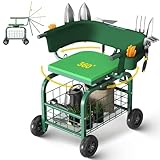
🎯 Garden Seat with Wheels for Seniors & Gardening Enthusiasts. Ideal for aging gardeners, DIY lovers, or anyone with limited mobility who spends long hours on garden tasks. Features an angle-adjustable handle that adapts to your posture for easy maneuverability. Say goodbye to back strain—this mobile garden wagon brings comfort and convenience right where you need it.
A knee implant does not automatically make kneeling unsafe. Individual surgical instructions still apply, particularly when the incision or surrounding skin has not fully healed.
When kneeling has been cleared, initial contact can occur on a soft, padded surface rather than immediately outdoors. A garden pad can reduce pressure, although any support used in the yard needs to remain stable on the surface underneath it. If you have not listened to Episode 93 (kneeling) yet, you can listen here.
Kneeling Is Not the Only Option
Ground-level gardening can involve several positions:
- Full kneeling with both knees down
- Half-kneeling with one knee down and one foot forward
- A supported squat
- Sitting on a sturdy garden stool or bench
Each option changes the amount of knee bend, balance, strength, and pressure required. A lower position is not automatically better. The useful position is one that a person can enter, maintain, and leave with control.
Before lowering toward the ground, it is also useful to know what stable support will be available for standing again. Lightweight planters, rolling carts, and decorative garden structures are not designed to support body weight.
Reduce the Work of Repeated Bending and Lifting
Long-handled gardening tools can reduce the number of repeated bends required for weeding, cultivating, or planting. The purpose is not to avoid bending entirely. Repeating the same movement hundreds of times can simply add fatigue when it is combined with walking, carrying, and prolonged positioning.

Versatile 2-in-1 Garden Tool: This versatile 2-in-1 weeding puller tool combines a weed rake and garden hoe in one smart design. Simply flip the tool to switch functions—use the strong metal teeth to lift weeds out from the roots, then turn to the flat blade to dig and loosen soil smoothly and efficiently. It allows you to handle multiple tasks with one tool, making everyday garden and lawn maintenance faster and more convenient.
Lifting deserves similar attention. Bags of soil, pots, hoses, mulch, and watering cans can become difficult because the load may need to travel over grass, gravel, slopes, or other uneven surfaces.
Smaller loads may be easier to control than one large load. Keeping an object closer to the trunk also generally requires less effort than holding it farther away. Turning with the feet rather than twisting over a planted leg can simplify the movement.
Let Time and Position Change the Workload
Gardening sessions can become demanding gradually because the activity is enjoyable and fatigue may not be obvious at first. A short session can provide useful information about how your knee responds later that day and the following morning.
Changing positions periodically may also reduce prolonged stiffness. Standing, walking to another bed, sitting for another task, and returning to a lower position later distributes the workload differently.
If a new session is followed by a substantial increase in joint pain, swelling, stiffness the next day, limping, or decreased motion, the combination of time, position, or load may have exceeded current capacity. Changing one variable at a time makes the response easier to interpret.
Uneven Ground Changes the Challenge
Gardens contain wet grass, loose soil, roots, hoses, stones, edging, and slopes. These conditions can increase the balance demands of an otherwise simple task.
Starting with level, dry surfaces can reduce the number of challenges being introduced at once. Supportive footwear, visible pathways, nearby tools, and loads that do not block the view of the ground can also simplify movement.
When Walking and Balance Still Feel Awkward
If walking over uneven surfaces still feels awkward, uneven, or tiring, Walking Like Yourself Again After Knee Replacement is an intentionally concise, evidence-informed guide that explains factors that can influence gait after surgery and how smoother, steadier movement often develops over time.

Why Walking Feels Awkward and How People Rebuild Smooth, Confident Walking for Everyday Life (The Total Knee Success Series Book 2)
Affiliate disclosure: This section contains Amazon affiliate links. As an Amazon Associate I earn from qualifying purchases at no additional cost to you.
Click here for some useful gardening tools you might like.
Three Common Questions About Gardening After Knee Replacement
Can I kneel in the garden after knee replacement?
Many people can kneel after knee replacement, but individual restrictions, incision healing, skin tolerance, knee motion, and balance can affect when and how the position is attempted. Research also shows that kneeling difficulty can persist even when other functions improve.
Is squatting better than kneeling?
Not necessarily. Squatting may reduce pressure on the front of the knee, but it can require substantial knee bend and leg strength. A stool, half-kneeling position, or other supported setup may fit some people better.
How long should a gardening session be?
There is no universal time limit. A shorter session can help reveal how a particular combination of bending, carrying, standing, and ground-level work affects the knee before several demands are increased together.
Gardening Can Be Rebuilt Piece by Piece
Returning to gardening does not depend on passing one test or reaching one calendar date. The activity can be divided into positions and jobs, with simpler versions used before more demanding combinations of kneeling, lifting, uneven ground, and longer work periods are added.
For ongoing practical education, sign up for the free Total Knee Success Insider using the form at the bottom of this page. It includes practical knee replacement education, new podcast episodes, and updates about helpful Total Knee Success resources.
Educational disclaimer: This article is for educational and informational purposes only. It does not provide diagnosis, treatment, or individualized medical advice and does not replace guidance from your surgeon, physical therapist, or other qualified healthcare professional. Sudden swelling, inability to bear weight, severe pain, calf pain, chest pain, shortness of breath, fever, drainage, or concerning redness deserves prompt medical evaluation.
References
- Wylde V, Artz N, Howells N, Blom AW. Kneeling ability after total knee replacement. EFORT Open Rev. 2019;4(7):460-467. doi:10.1302/2058-5241.4.180085
- Nadeem S, Mundi R, Chaudhry H. Surgery-related predictors of kneeling ability following total knee arthroplasty: a systematic review and meta-analysis. Knee Surg Relat Res. 2021;33(1):36. doi:10.1186/s43019-021-00117-z
- Konnyu KJ, Thoma LM, Cao W, et al. Rehabilitation for total knee arthroplasty: a systematic review. Am J Phys Med Rehabil. 2023;102(1):19-33. doi:10.1097/PHM.0000000000002007
- Jette DU, Hunter SJ, Burkett L, et al. Physical therapist management of total knee arthroplasty. Phys Ther. 2020;100(9):1603-1631. doi:10.1093/ptj/pzaa099
- Peters MCWM, Pronk Y, Brinkman JM. Eight of ten patients return to daily activities, work, and sports after total knee arthroplasty. World J Orthop. 2024;15(7):608-617. doi:10.5312/wjo.v15.i7.608
- Orange GM, Hince DA, Jones M, et al. Physical function following total knee arthroplasty for osteoarthritis: a longitudinal systematic review with meta-analysis. J Orthop Sports Phys Ther. 2025;55(1):1-14. doi:10.2519/jospt.2024.12361
- Shah OA, Matar HE, Platt SR, et al. Patellar resurfacing and kneeling ability after total knee arthroplasty: a systematic review. Knee Surg Relat Res. 2023;35(1):17. doi:10.1186/s42836-023-00184-5