
Sleep positions after knee replacement can be surprisingly difficult to manage. Your usual position may be uncomfortable, your knee may become stiff when you remain still, and swelling or medication timing may interrupt your sleep.
There is no single position that everyone must maintain throughout the night. The practical goal is to support your leg, avoid prolonged twisting or pressure, and follow any specific positioning instructions provided by your surgeon.
Sleep disruption is common after knee replacement
Difficulty sleeping does not necessarily indicate a problem with your knee replacement. A prospective study found that sleep quality commonly worsened during the first six weeks after surgery and then improved at three and six months.1
Pain is one possible contributor, but it is not the only one. Swelling, stiffness, reduced daytime activity, medication schedules, stress, and the challenge of finding a comfortable position can all interrupt sleep.
The best sleep position is usually the one that supports your leg without forcing your knee or creating new discomfort elsewhere.
Expecting perfect sleep can add another layer of frustration. A more realistic goal is to create several supported options and change positions when remaining still becomes uncomfortable.
Sleeping on your back
Back sleeping is commonly recommended because it allows your leg to rest in a relatively neutral position. It also makes it easier to see your leg and arrange support beneath it.
If you elevate your leg, distribute the support beneath the lower leg rather than placing one thick pillow directly behind your knee. Concentrated support behind your knee can keep it in a flexed position for a prolonged period.
The goal is not to force your knee flat. Support the lower leg so your knee can remain as straight as it comfortably can while you rest. Follow different positioning instructions if your surgeon or physical therapist has given them to you.
As an Amazon Associate I earn from qualifying purchases. The FifthQuarter wedge set is included in an Amazon Creator Connections campaign, which may provide an additional commission at no added cost to you.
The FifthQuarter 6-piece orthopedic wedge pillow set provides several adjustable support pieces instead of one fixed wedge. That flexibility is useful because you can support your back and lower leg in different configurations as your comfort and mobility change.
The set includes memory foam and high-density foam, removable covers, and pieces that can be arranged for upright rest or lower-leg elevation. For knee positioning, arrange the support beneath your calf and lower leg so your knee remains as straight as it can comfortably be. Avoid creating one pressure point directly behind your knee.
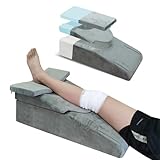
Height Adjustable Leg Pillow: ChunxiFurnis knee extending pillow is adjustable in Four heights from 6 inches to 9.5 inches by putting it in different configurations. This leg elevation pillows for after surgery is excellent for promoting post-surgery recovery, relieving knee pain, back pain, sciatica pain and leg swelling
Sleeping on your side
Side sleeping may become comfortable when your symptoms and surgical instructions allow it. When lying on your nonsurgical side, support the surgical leg so it does not drop forward or rotate across your other leg.
A pillow extending from your thigh toward your ankle generally provides more complete support than a small cushion placed only between your knees.
The Contour Legacy leg and knee foam support pillow is shaped to fit between the legs during side sleeping. It can help separate your knees and reduce direct pressure between them. Because it is shorter than a full body pillow, check whether your lower leg also needs support to keep your surgical leg comfortable and aligned.
Sleeping directly on your surgical side is more variable. Incision sensitivity, swelling, and pressure may make that position uncomfortable for several weeks. Do not force it. You can try again later when the area is less sensitive and your surgeon has not placed a restriction on that position.
Using a recliner temporarily
Some people sleep more comfortably in a recliner during the early days because getting into bed is difficult or lying flat increases discomfort. A recliner can be a temporary option, but it should not leave your knee deeply bent for most of the day and night.
Physical therapy guidelines emphasize restoring knee extension through positioning and active movement.2 If you sleep in a recliner, include periods during the day when your lower leg is supported in a more neutral position, according to your therapist’s instructions.
Use cold therapy before sleep, not while sleeping
When swelling and discomfort interfere with settling into bed, cold therapy may be useful before sleep if your surgical team permits it.
The Chattanooga ColPac reusable gel ice pack is a straightforward option that can conform around part of your knee. Use a protective layer between the pack and your skin and follow the recommended application time.
The DonJoy Iceman CLASSIC3 cold therapy unit provides circulating cold therapy for people who prefer a machine and have been cleared to use one. Follow the device instructions and your surgeon’s protocol carefully.
Do not fall asleep with a gel pack or cold therapy unit operating unless your surgeon has explicitly instructed you to use that specific device during sleep. Reduced sensation and prolonged exposure can injure your skin.
Position changes are allowed
Moving during the night does not mean you damaged your knee replacement. Gentle position changes may reduce stiffness and pressure. Move carefully, especially if medications make you sleepy or unsteady.
Avoid a position that creates persistent twisting, substantial pressure on your incision, or increasing pain that does not settle after you reposition. Contact your healthcare team if sleep is disrupted by escalating pain, new wound concerns, marked swelling, calf symptoms, or another significant change.
For a deeper explanation of why pain can change from one night to another, visit Making Sense of Pain After Knee Replacement. It is an intentionally concise guide to activity, swelling, sleep, stress, medication timing, and nervous system sensitivity.

Why Your Knee Still Hurts, Feels Tight, and Changes From Day to Day (The Total Knee Success Series Book 1)
For continuing practical education, be a Total Knee Success Insider. You will receive new episodes and resources relevant to your stage of the knee replacement process.
Comfort and positioning can change over time
A position that does not work during your first week may become comfortable later. You may also use different positions during the same night. Support your leg, avoid forcing your knee, and adjust your setup as swelling and sensitivity change.
Episode 31 compares home physical therapy with outpatient physical therapy, including who may benefit from each setting and which practical factors influence the decision.
Join the free Total Knee Success Insider for practical knee replacement education, new podcast episodes, and helpful resources. You can also sign up using the form at the bottom of this page.
This article provides general educational information. It does not prescribe a sleep position, diagnose a condition, replace an examination, or establish a physical therapist-patient relationship. Follow positioning, incision-care, and cold-therapy instructions provided by your surgeon and physical therapist.
References
- Chen AF, Orozco FR, Austin LS, Post ZD, Deirmengian CA, Ong AC. Prospective evaluation of sleep disturbances after total knee arthroplasty. J Arthroplasty. 2016;31(1):330-332. doi:10.1016/j.arth.2015.07.044
- Jette DU, Hunter SJ, Burkett L, et al. Physical therapist management of total knee arthroplasty. Phys Ther. 2020;100(9):1603-1631. doi:10.1093/ptj/pzaa099
- Owens MA, et al. Presurgical sleep and pain behaviors predict insomnia symptoms and pain after total knee replacement. Arthritis Care Res (Hoboken). Published online 2023.
- Gong L, Wang Z, Fan D. Sleep quality effects early functional outcomes after total knee arthroplasty: a randomized, double-blind, controlled study. J Arthroplasty. 2015;30(11):1897-1901. doi:10.1016/j.arth.2015.02.020