
When should you walk more after knee replacement? The answer depends on more than pain during the walk. Distance, speed, terrain, fatigue, movement quality, swelling, confidence, and how your knee responds later all provide useful information.
Walking more is not automatically better, and a temporary increase in symptoms does not automatically mean that walking caused damage. The pattern surrounding the activity is more informative than one isolated sensation.
In Episode 42 of the Total Knee Success Podcast, Michelle Losurdo, PT, DPT, OCS, explains how walking can be progressed without relying on guesswork or generic step goals.
When to walk more after knee replacement
Walking is not one single activity. A longer distance, faster pace, uneven surface, reduced hand support, or fewer rest periods can each increase the physical demand.
This is why advice to “just keep walking” is incomplete. Your physical therapist can help determine which part of your walking should change and whether walking is currently the most useful activity to progress.

Google Fitbit Air is the unbelievably comfortable, exceptionally smart way to transform your health[1]; and Google Health brings together effortless tracking and adaptive coaching to help make the most of your everyday[2]
A stable walking distance that produces a predictable response provides a useful starting point. If the same distance becomes easier, your walking remains reasonably smooth, and symptoms return toward their usual level, your clinician may determine that a small increase is appropriate.
Progressing a walk is not simply doing more. It is changing one demand and evaluating how your body responds.
Increasing speed, distance, and terrain during the same walk makes it difficult to identify which change influenced your response. Adjusting one variable at a time provides clearer information.
What happens later may be more informative
Pain during walking receives considerable attention, but your response later that day and the following morning may provide additional information about tolerance.
Mild stiffness or aching can occur as activity changes. A different pattern appears when pain, swelling, stiffness, guarding, or limping becomes progressively worse and remains elevated for an extended period.
There is no universal number of hours that defines an acceptable response for every person. Stage after surgery, medical history, current symptoms, and the specific activity all affect interpretation. Your physical therapist can help establish what returning toward baseline should look like for you.
Sharp pain, catching, new instability, a sudden substantial increase in swelling, calf pain, chest pain, shortness of breath, fever, drainage, or another concerning change should not be treated as an ordinary walking response. Seek appropriate medical guidance.
Fatigue can change movement quality
Some fatigue is expected when strength and endurance are developing. Fatigue becomes more relevant when it changes how you walk.
You may begin taking shorter steps, leaning farther to one side, dragging your foot, relying more heavily on support, or placing less weight through your surgical leg. Continuing to add distance after movement quality has declined may reinforce compensation rather than provide useful walking practice.
If the same distance feels increasingly demanding across several walks, additional walking may not address the limiting factor. Quadriceps strengthening, balance activities, sleep, rest, nutrition, or another component of your plan may need attention.
Episode 41 explains what walking speed after knee replacement can reveal. Episodes 39 and 40 provide more information about quadriceps weakness and muscle activation.
Assistive devices can support walking progression
A cane or walker may allow a person to practice a smoother pattern, walk a useful distance, and reduce fall risk. Removing the device does not automatically represent better function if walking becomes more uneven or guarded without it.
As an Amazon Associate I earn from qualifying purchases.
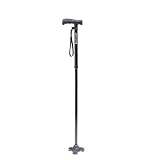
Enhanced Stability: The HurryCane Foldable Walking Cane provides balance support for confident mobility, featuring a patented SteadiGrip base and a WhisperFlex pivoting design
If your physical therapist recommends a cane, this self-standing pivot walking cane may be convenient because it can remain upright when placed beside a chair. For someone who requires greater support or benefits from an available seat, this rollator walker is another option to review with a clinician.
The correct device depends on balance, upper-body strength, weight-bearing status, endurance, home environment, and walking pattern. A rollator is not interchangeable with every standard walker, and either device must be adjusted and used correctly.
Distance, speed, and terrain are different progressions
Increasing distance develops tolerance for longer activity. Increasing speed requires greater force production, balance, timing, and confidence. Changing terrain requires faster adjustments to uneven or unpredictable surfaces.
A person may be ready for a slightly longer walk on a level surface without being ready to walk quickly or navigate grass and gravel. Another person may tolerate brief changes in pace while needing to maintain the same total distance.
Some rehabilitation plans use small percentage increases after a distance has become predictable. Other plans alternate shorter and longer walks or use time rather than distance. These are examples, not universal prescriptions.
The appropriate structure depends on your current abilities and the activities you need to resume. Your therapist can also determine whether an increase in walking should replace another activity or be added to the total workload.
If you want practical education about rebuilding walking, Walking Like Yourself Again After Knee Replacement is an intentionally concise guide available in Kindle and paperback formats.
Confidence is one part of readiness
Confidence does not require ignoring symptoms. It includes knowing that you can manage a change in surface, fatigue, or discomfort without losing control.
Signs of improving confidence may include smoother turns, less hesitation, more consistent pacing, and reduced dependence on nearby furniture. These changes can occur before a substantial increase in distance.
If confidence remains limited, practicing longer walks is not always the most direct answer. Supervised balance work, turning practice, gait training, or strengthening may address the specific problem more effectively.
If you want ongoing education for the stage you are in, be a Total Knee Success Insider. The newsletter includes new episodes and useful knee replacement resources.
Walking is one part of the overall workload
Physical therapy exercises, household activities, appointments, stairs, errands, and walking all contribute to the total demand placed on your body. A walk that is well tolerated on a quiet day may produce a different response after therapy or several hours of activity.
This variability does not make the information useless. It means the surrounding context belongs in the interpretation. Looking at several days can reveal more than reacting to one unusually good or demanding day.
The goal is not to accumulate the largest number of steps. It is to build walking that supports everyday function without repeatedly overwhelming the capacity available at that stage.
Join the free Total Knee Success Insider for practical knee replacement education, new podcast episodes, and helpful resources. You can also sign up using the form at the bottom of this page.
References
- Jette DU, Hunter SJ, Burkett L, et al. Physical therapist management of total knee arthroplasty. Phys Ther. 2020;100(9):1603-1631. doi:10.1093/ptj/pzaa099
- Orange GM, Hince DA, Travers MJ, et al. Physical function following total knee arthroplasty for osteoarthritis: a longitudinal systematic review with meta-analysis. J Orthop Sports Phys Ther. 2025;55(1):1-11. doi:10.2519/jospt.2024.12570
- Christensen JC, Capin JJ, Hinrichs LA, et al. Gait mechanics are influenced by quadriceps strength, age, and sex after total knee arthroplasty. J Orthop Res. 2021;39(7):1523-1532. doi:10.1002/jor.24878
- Jogi P, Overend TJ, Spaulding SJ, Zecevic A, Kramer JF. Effectiveness of balance exercises in the acute postoperative phase following total hip and knee arthroplasty: a randomized clinical trial. SAGE Open Med. 2015;3:2050312115570769. doi:10.1177/2050312115570769
- Fritz S, Lusardi M. White paper: walking speed: the sixth vital sign. J Geriatr Phys Ther. 2009;32(2):46-49. doi:10.1519/00139143-200932020-00002
Educational disclaimer: This article provides general educational information and does not constitute medical advice, diagnosis, or treatment. Walking progression, symptom interpretation, balance activities, and assistive-device selection should be individualized by qualified healthcare professionals who know your surgical timeline and medical history.