
Learning to walk naturally after knee replacement involves more than trying not to limp. Pain, swelling, knee motion, quadriceps strength, balance, walking speed, confidence, and the assistive device all influence your gait.
A limp is an observation, not a diagnosis. The same visible pattern can arise from different limitations, so the useful starting point is identifying why your walking has changed.
Prefer to listen? Play Episode 2 below for the complete discussion.
Why Walking Changes After Knee Replacement
Your walking pattern may have changed before surgery because of pain, stiffness, weakness, or reduced trust in your leg. Those adaptations do not necessarily disappear when the joint surfaces are replaced.
After surgery, swelling can limit knee motion and temporarily reduce quadriceps activation. Pain may shorten the time spent on the surgical leg. A walker or cane changes how weight is distributed, and fatigue may make each step less controlled.
Walking more is not always the same as walking better. Distance, speed, symmetry, control, and fatigue describe different parts of gait.
A physical therapist can observe which part of the gait cycle is limited and compare it with strength, motion, balance, pain, swelling, and device use. That assessment is more useful than a general instruction to “stop limping.”
5 Factors That Help You Walk Naturally After Knee Replacement
1. Appropriate Weight Acceptance
Walking requires transferring body weight onto one leg while the other leg advances. Pain, weakness, or uncertainty may cause a person to spend less time on the surgical side and take a shorter step with the opposite leg.
Weight-bearing restrictions and progression differ. Follow your surgeon’s instructions and use the prescribed device. A therapist may use supported weight shifts, stepping tasks, or other activities after determining that they are appropriate.
2. Knee Motion at the Right Time
Your knee normally straightens as your body passes over the supporting leg and bends as your foot leaves the floor. Limited extension may keep your knee flexed during stance, while limited flexion may reduce foot clearance during swing.
Trying to force a larger step does not correct every motion problem and may create compensation elsewhere. Your therapist can determine whether motion, strength, timing, pain, or swelling is the primary limitation.
3. Quadriceps and Hip Strength
Your quadriceps help control your knee as weight transfers onto the leg. Hip muscles help stabilize your pelvis and guide leg position. Weakness in either area may change step length, trunk position, balance, or confidence.
Walking provides repeated practice, but it may not supply enough resistance to rebuild all the strength needed for stairs, curbs, low chairs, or faster walking. Strengthening should be selected and progressed according to examination findings.
4. A Properly Selected Assistive Device
A walker or cane may improve safety, reduce excessive compensation, and allow more controlled practice. Moving away from a device too soon can reinforce a pronounced limp or increase fall risk. Continuing to use one longer is not a failure when it still serves a clear purpose.
Device type, height, hand placement, and walking sequence should be checked by a healthcare professional. A cane is commonly held opposite the affected leg, but personal circumstances may require a different plan.
5. Practice Across Relevant Environments
A quiet hallway provides a predictable place to practice. Real life may include carpet, ramps, curbs, crowds, uneven ground, changing speeds, and carrying objects. Each environment adds a different demand.
Practice should progress only when the current level is controlled and safe. Someone with repeated falls, dizziness, substantial balance loss, new weakness, or neurologic symptoms needs assessment before adding more difficult conditions.
Walking Quality Can Change With Fatigue
A person may walk smoothly for several minutes and then begin shortening steps, leaning, or using the device differently. That pattern provides information about endurance and current capacity.
Walking farther while form deteriorates is not always the most useful progression. Shorter, higher-quality practice periods may be appropriate until endurance improves. Your therapist can determine how distance, duration, speed, and rest should change.
Walking Tools and Additional Education
Affiliate disclosure: This section contains an Amazon affiliate link. As an Amazon Associate I earn from qualifying purchases at no additional cost to you.
A self-standing cane may be convenient when a cane is clinically appropriate. Confirm the correct device, height, weight capacity, hand placement, and sequence with your therapist before use.
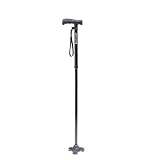
Enhanced Stability: The HurryCane Foldable Walking Cane provides balance support for confident mobility, featuring a patented SteadiGrip base and a WhisperFlex pivoting design
For an intentionally concise explanation of gait, compensation, strength, balance, and walking practice, visit Walking Like Yourself Again After Knee Replacement. You can also receive the free Top 10 Walking Tips.
When a Walking Change Needs Assessment
Contact your healthcare team for sudden loss of function, new inability to bear weight, repeated giving way, a new foot drop, rapidly increasing pain or swelling, increasing redness or warmth, wound drainage, fever, new calf pain, or one-sided leg swelling.
Chest pain, unusual shortness of breath, fainting, or another possible emergency requires immediate evaluation. Do not treat a sudden walking change as a routine gait problem without considering a medical cause.
Walking Is a Skill and a Physical Task
To walk naturally after knee replacement, your body needs sufficient motion, strength, balance, timing, and endurance. The most useful practice addresses the factor limiting your gait rather than pursuing a perfect-looking step.

Why Walking Feels Awkward and How People Rebuild Smooth, Confident Walking for Everyday Life (The Total Knee Success Series Book 2)
The Total Knee Success Insider signup is available at the bottom of this page for practical education, new podcast episodes, and updates about helpful resources.
Educational disclaimer: This article provides general educational information and does not provide diagnosis, treatment, gait training, device prescription, or an individualized exercise plan. Follow your surgeon’s weight-bearing and postoperative instructions. Consult your physical therapist or another qualified healthcare professional before changing your device, walking pattern, exercise program, or activity level.
References
- American Physical Therapy Association. Clinical practice guideline: physical therapist management of total knee arthroplasty. Phys Ther. 2020;100(9):1603-1631. doi:10.1093/ptj/pzaa099.
- Mont MA, Beaver WB, Dysart SH, Barrington JW, Del Gaizo DJ. Local infiltration analgesia in total knee arthroplasty: a randomized controlled trial. J Arthroplasty. 2018;33(1):90-95. doi:10.1016/j.arth.2017.08.017.
- Wylde V, Rooker J, Halliday L, Blom A. Acute postoperative pain at rest after hip and knee arthroplasty: severity, sensory qualities and impact. Musculoskeletal Care. 2011;9(4):201-209. doi:10.1002/msc.204.
- Smith TO, Chester R, Clark A, Donell ST. Cross-sectional study into peri-operative practices surrounding total knee replacement surgery in the UK. Knee. 2012;19(5):365-369. doi:10.1016/j.knee.2011.06.010.
- The Knee Journal. Reduced knee flexion in TKA patients: carryover of preoperative gait patterns. Knee. 2021.
- McClelland JA, Webster KE, Feller JA. Gait analysis of patients following total knee replacement: a review. PMCID: PMC3754839.