
Tools for the first two weeks after knee replacement should solve practical problems rather than create a larger shopping list. Cold therapy, stable elevation, clinician-approved compression, secure footwear, and a leg lifter may support comfort, swelling management, mobility, and independence for selected people.
These products are not requirements, and no single list fits everyone. Your surgical instructions, home layout, mobility, medical history, and available help should guide what you prepare.
See all five tools featured in Episode 83 on Amazon.
As an Amazon Associate I earn from qualifying purchases.
1. Cold therapy that is practical to use
Swelling can influence comfort, movement, sleep, walking, and quadriceps activation during the early period after surgery. Some surgical programs provide a cold therapy machine. Other people use reusable gel packs.
A machine may be convenient during longer periods in one location. A large, flexible gel pack may be easier for shorter sessions and remains useful for other purposes later. One machine you can review is the DonJoy Iceman Classic3 cold therapy unit. The best option is one that fits the instructions you receive and can be used safely in your home.
A useful tool reduces friction. It does not replace the plan provided by your surgical team.
Cold can injure skin when it is too intense or used improperly. Follow your surgeon’s instructions regarding placement, skin protection, session length, frequency, wound care, and whether cold therapy is appropriate for you. Reduced sensation and vascular conditions may require additional precautions.

Cold therapy unit helps reduce pain and swelling, speeding up rehabilitation
2. A stable elevation setup
Several loose pillows may shift as your leg moves. An adjustable leg-elevation wedge can make the setup easier to reproduce, but the shape and position must support the instructions you were given.
Elevation should not place your leg in a position that conflicts with your surgeon’s or physical therapist’s recommendations. Ask where the support should contact your leg and how your knee should be positioned.
The practical benefit is consistency. When the setup is ready, you have one less arrangement to rebuild while you are tired, uncomfortable, or managing several other tasks.
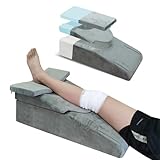
Height Adjustable Leg Pillow: ChunxiFurnis knee extending pillow is adjustable in Four heights from 6 inches to 9.5 inches by putting it in different configurations. This leg elevation pillows for after surgery is excellent for promoting post-surgery recovery, relieving knee pain, back pain, sciatica pain and leg swelling
3. Compression approved by your surgical team
Swelling may extend beyond your knee into your lower leg, ankle, and foot. Some surgeons prescribe compression stockings, an elastic wrap, or another form of compression. Other surgical programs use different protocols.
Compression type, pressure, placement, and wearing schedule should come from your healthcare professionals. Compression is not appropriate in every situation, and incorrect use can create skin, circulation, or pressure problems.
Do not substitute a product from an online list for the specific compression method prescribed to you. Ask before surgery what will be supplied, what you may need at home, and who should apply it.

Truform 0868; Medical support hose; Unisex style durable knit; 20-30 strength graduated compression
4. Supportive shoes that are easy to put on
Bending to manage laces may be uncomfortable during the first two weeks. Your usual shoes may also fit differently if your foot or ankle becomes swollen.
Choose footwear that stays securely on your foot and provides dependable traction. Loose slippers, worn soles, or shoes that slide at the heel can add an avoidable challenge when you are already using an assistive device or adapting your walking.
Try the shoes before surgery. You can browse supportive easy-on shoe options, but your physical therapist can help determine whether a particular pair is appropriate for your walking and home environment.

EFFORTLESS SLIP-ON DESIGN: These slip on shoes for women feature a convenient hands-free entry system with fixed stretch laces and Heel Pillow technology for secure fit
5. A leg lifter strap for selected transfers
Quadriceps activation commonly becomes more difficult after knee replacement. A person may be able to stand and walk with support but still have trouble lifting the surgical leg onto a bed, couch, or vehicle seat.
A leg lifter strap may provide temporary assistance with positioning and selected transfers. It is not intended to replace muscle activation or the movement strategies taught by your physical therapist.
Ask a rehabilitation professional whether a leg lifter is appropriate and how to use it. Pulling your leg into an unsafe position or using the strap during a transfer that requires hands-on assistance can increase risk.

MULTI-LOOP HANDLE 42 INCH LEG LIFTER FOR EASIER HOLD AND MORE EFFECTIVE MANEUVERABILITY FOR WEAK OR INJURED LEGS---Whether you're recovering from a leg injury, hip surgery, or dealing with limited mobility, the multi-loop handle design offers a more comfortable and secure grip that allows for better control when positioning your leg on a bed, wheelchair, or even in a car.
Choose tools for your actual home and plan
Someone living alone may prioritize independence differently than someone with help throughout the day. A person beginning outpatient therapy quickly may prepare for car transfers, while someone receiving home care may have different needs.
Picture an ordinary day during the first week. Consider where you will sit, use cold therapy, elevate your leg, keep essential items, put on shoes, and move between your bed and bathroom. Then compare that picture with the instructions from your surgical team.
Seek prompt medical attention for fever, new wound drainage, rapidly increasing redness or swelling, severe uncontrolled pain, new calf pain or one-sided swelling, fainting, or another rapidly worsening symptom. Chest pain or unusual shortness of breath requires emergency evaluation.
Review the complete Episode 83 product collection
You can see all five items featured in Episode 83 on Amazon. This lets you compare the products together and decide which, if any, fit the instructions you have received and the practical needs of your home.
Download the free 2-Week Knee Replacement Launch Plan for an educational checklist covering the final 14 days before surgery.
The Total Knee Success Insider signup is available at the bottom of this page. Listen to the complete Episode 83 discussion using the player above.
References
- Liang Z, Zhu C, Chen X, et al. Cryotherapy for rehabilitation after total knee arthroplasty: a systematic review and meta-analysis. J Orthop Surg Res. 2024;19:1-12.
- Quesnot A, Guillot S, Laurent A, et al. Randomized controlled trial of compressive cryotherapy versus standard cryotherapy after total knee arthroplasty. BMC Musculoskelet Disord. 2024;25:1-10.
- Christensen LMR, Overgaard S, Bagger J, et al. The effect of compression therapy on post-surgical swelling and pain after total knee arthroplasty. Int J Orthop Trauma Nurs. 2021;41:100815.
- Munk S, Jensen NJF, Andersen I, Kehlet H, Hansen TB. Effect of compression therapy on knee swelling and pain after total knee arthroplasty. Knee Surg Sports Traumatol Arthrosc. 2013;21(2):388-392.
- Thomas AC, Stevens-Lapsley JE. Importance of attenuating quadriceps activation deficits after total knee arthroplasty. Exerc Sport Sci Rev. 2012;40(2):95-101.
- Arhos EK, Ito N, Mayer IM, et al. Who’s afraid of electrical stimulation? Let’s revisit the application of NMES at the knee. J Orthop Sports Phys Ther. 2024;54(2):101-107.
- Orange GM, Hince DA, Jones M, et al. Physical function following total knee arthroplasty for osteoarthritis: a longitudinal systematic review and meta-analysis. J Orthop Sports Phys Ther. 2025;55(1):1-14.
Educational Disclaimer: This article provides general educational information and does not replace medical advice, product recommendations for an individual, wound-care instructions, exercise prescription, home-safety assessment, or individualized rehabilitation. Follow the instructions provided by your surgeon and rehabilitation professionals. Seek prompt medical care for severe, rapidly worsening, or concerning symptoms.